
Note: This exhibition is scheduled to close on 6/30/07.It was not long after the 9/11 attacks when artist Taraneh Hemami, a native of Iran, came across a U.S. government poster showing headshots of the “most wanted international terrorists.” Or rather, she came across a small, low-resolution image of this poster (see above). The faces were not identifiable although many of the figures appeared to be Middle Eastern. As the artist commented to me, “They could be anybody.”
Hemami has been exploring this material for awhile, and her current exhibition at
Intersection for the Arts in San Francisco uses it as the kernel for a superb installation. Through a variety of devices, she evokes the climate of ignorance, fear, and depersonalization that now influences how people in the West react to people of Middle Eastern descent. With a sardonic flourish, she calls the show “Most Wanted.”
The exhibit begins in the stairway that leads to the second-floor exhibition space. Visitors encounter a stair carpet imprinted with Middle Eastern names (in English) running down the center in a single column. It looks a bit like a memorial. You can avoid stepping on the names if you widen your gait a bit. Further up, though, you reach a carpet that has
two columns of names. Here it’s hard to proceed without treading on the names. At the top, entering the gallery, you see a timeworn wall covered in Farsi script, repeating the names on the stairs. (Images below.)


The blurred headshots are put to several uses. In one, the entire government poster is transformed into a decorative bead curtain, like a cozy adornment in an Iranian home. (Images below.)


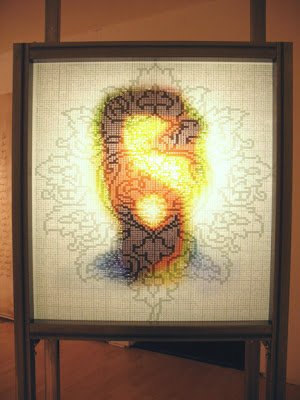
Some of the single headshots, reproduced as large copies, are mounted in a lightbox array that has two sides. The outward side is meant to suggest the bars of imprisonment. The inner portion, where floral carpet patterns are added to the images, is meant to recall the photos seen on Iranian gravesites. (Images below.)

On a wall in the rear stairwell, a video projection shows a series of headshots morphing into each other. What's disturbing is that the inability to read these images begins to feel like a defect of mind. (Image below.)
 ____________________
 Hemami's imagery addresses a social and psychological condition, but it's interesting to note that there is also a medical condition, called prosopagnosia, which limits the recognition of faces. There is a brief but informative Wikipedia article on this rare condition.
 Note: This exhibit is scheduled to close on 6/15/07.
 At the top and below are further examples of the work. The final image is a wall installation (image from the gallery website).


