Wednesday, April 26, 2006

Scion Dashboard

Recently I have received invitations to private receptions at the Scion Dashboard Gallery, a promotional effort by the car brand. The aim is to sell the brand to young people by associating it with artwork that looks young and preferably “street.” You know: graffiti, skulls, sci-fi, bad-ass language, and like that, bro. The San Francisco edition is happening in a temporary space in San Francisco’s Hayes Valley shopping district. The show will turn over 4 times in 4 weeks. I declined the party invitation but took a peek at week one. I knew there would be a Scion logo somewhere, but I had no idea that customize-your-Scion DVDs would be presented in trade-show fashion (photo above) or that a Scion car would be sitting in the center of the show, doors open.

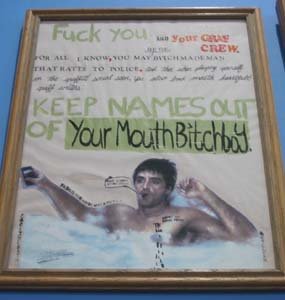
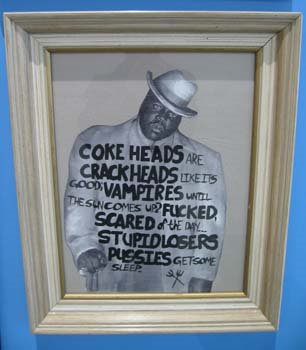
The only art that registered at this viewing were some rap-like pieces by an artist whose name I didn’t get. One example shows a young Al Pacino talking tough about graffiti wars, it seems (photo above). Another one—it's good and punchy—shows the murdered rapper Biggie Smalls (photo below).

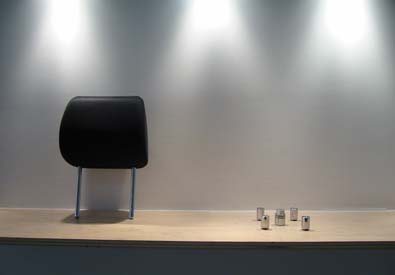
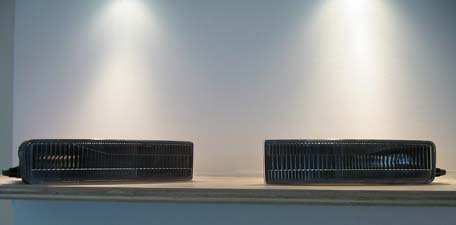
Unintended art moments in a completely different style were provided by some spotlighted displays of Scion parts (photos below). Shades of Haim Steinbach! I think my favorite is the one with the headrest, although the fog lights run a close second.

Art Chicago Reported in Disarray

Art Chicago, the major art fair in Chicago for the past 13 years, was scheduled to open on Thursday, April 27th. On Monday, the Chicago Tribune reported that the event was in disarray. Coverage by that paper continues. A good way to access this coverage is to use 'Art Chicago' as a search term in Google News.

In the past six months, the producer of this fair, Thomas Blackman Associates of Chicago, has made late-hour cancellations of two art fairs scheduled for San Francisco and New York. If the Chicago event collapses, the chances for another art fair under the Thomas Blackman banner would seem to be nil. To outsiders, it has appeared that Blackman was failing to adapt to the surge in popularity of competing U.S. art fairs, such as Art Basel Miami Beach and the Armory Show in NYC.

Tuesday, April 25, 2006

New Exhibits This Week

Starting today, Lincart opens a solo exhibit of Tucker Nichols, featuring drawings, sculpture, and an installation. Nichols has been a welcome presence in San Francisco’s non-profit art venues and has been shown by commercial galleries as well. His most recent New York show was in Chelsea at ZieherSmith Gallery. A few months ago, he did an excellent installation as part of a group show at Gallery 16 (SF). Lincart is located at 1632-C Market St., San Francisco (near Zuni Café). There is a reception for the artist on Thursday, April 27th, from 6:00 to 9:00 pm. (Image above from the gallery website.)

In the Inner Sunset district of San Francisco, Receiver Gallery opens a group photo show with a reception on Saturday, April 29th, from 7:00 to 10:00 pm. The address is 1314 8th Ave., near Irving St. The photo above is by one of the participants, Jessica Miller (image from gallery website).

Mills College in Oakland is opening its 2006 MFA show on Sunday, April 30th, from 2:00 to 4:00 pm. The show runs through May 28th. A dozen graduating artists will be presented. Mills has a strong art studio program, so this is a key event for people who follow the Bay Area art scene. Mills is located far into Oakland, but it’s not hard to find by freeway if you follow the directions provided on the college website.

“Elusive Materials” at New Langton (SF)

Another exhibition that closed on Saturday was “Elusive Materials” at New Langton Arts in San Francisco. This project was designed to show the work of artists “who have contributed to Langton’s history, and whose own practice involves an archival drive.”
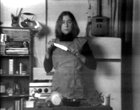
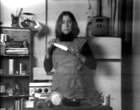
It was meant to be a conceptual show, and it was. Happily, two participants were well-known women artists who demonstrated that conceptualism needn’t be dry. In signature works from the 1970s, they underlined a common theme of the Women’s Movement of that era, “the personal is the political.” Martha Rosler’s famous 7-minute B&W video from 1975, “Semiotics of the Kitchen,” shows herself demonstrating everyday kitchen implements, as if she’s on a TV cooking show. She performs with a deadpan face and voice but with angry gestures. The piece retains its bite. A brief excerpt can be streamed from the artist’s website. (Image above is from Electronic Arts Intermix.)

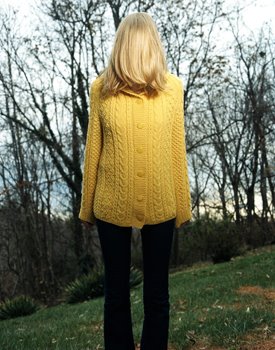
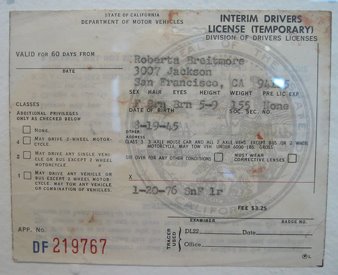
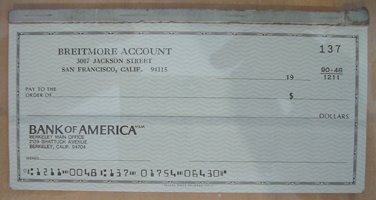
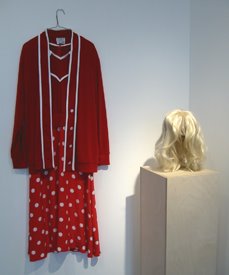
Stranger territory was explored by Lynn Hershman Leeson in a project that unfolded over most of the 1970s. The artist created the identity of a fictional person named Roberta Breitmore, using wigs, makeup, clothing, and altered behavior (photo at top). Roberta got a driver’s license (photo above), opened a checking account (photo below), qualified for credit cards, rented an apartment, placed classified ads to meet people, underwent a psychiatric evaluation, and so on. Eventually several other women (“multiples”) played Roberta as well. The presentation at New Langton is called “Roberta Breitmore’s Archive 1974-1978.” It includes the psychological evaluation (on letterhead), written in a dissociated style that was typical among psychiatrists but which seemed to echo the project’s creepy, fascinating investigation of identity.

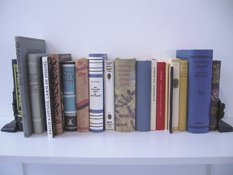
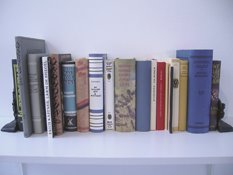
Rosler and Hershman Leeson stole the show, but there were other works of some interest. James Tantum covered a huge wall with his obsessive hand-drawn personal calendars. On another wall, Allan Ruppersberg’s compact “Siste Viator” was installed. The Latin phrase, used on Roman tombstones, can be translated as “Pause, Wanderer” but is rendered as "Stop Traveler" for this piece. In appearance this work from 1993 is a small shelf of books in several languages, with dust covers that look old-fashioned but freshly printed (photo above left). The books are replicas made by the artist. Only an historical sleuth of considerable skill could discover the meaning of this work without a crib sheet. What you see are books that might have been read by young soldiers from four countries who fought the Battle of Arnhem in 1944. It is a memorial for the 8,000 who were killed. I think the piece is too clever by half, and why do the books look untouched? Still, once understood, the work leaves a trail in the mind.
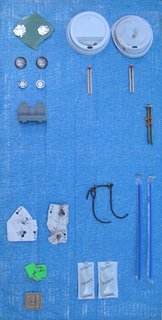
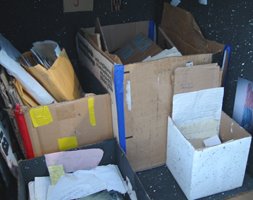


Colter Jacobsen’s project was to re-create a version of his studio space. Lots of images and bits of text were arranged on one wall. One section (top photo immediately above) showed the frequent Jacobsen theme of pairing. The two packets of honey near the bottom make it clear that the artist is not talking about math. (Felix Gonzalez-Torres’s dual synchronized clocks are a favorite of this artist.) On the floor in front of the wall, a couple of boxes served as cubbyholes where personal materials are stored (bottom photo above). The temptation to root through these was strong, but I resisted.
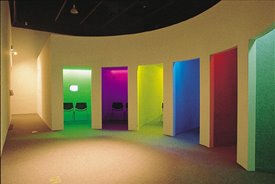
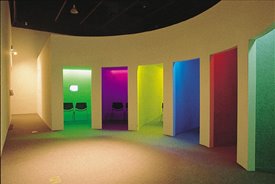
On the ground floor was an elaborate installation by Catalan artist Antonio Muntadas. It was his video work, “Between the Frames: The Forum.” Seven tiny video rooms were arranged side by side along an arc. The walls between the doorways suggested a colonnade around a public space. Multicolored lights bathed this structure, making it look (to me) like an opera set. The photo at right, taken from the New Langton website, shows a similar installation of the work at MIT.

In the video rooms, the screens presented an edited version of Muntadas’s 160 hours of interviews with art dealers, collectors, museum staff, critics, etc. The interviews were done in the 1980s and reflect the hype and greed of the 80s art market. There isn’t a section devoted to artists, although I understand the Epilogue includes a few artists talking. The total playing time for all the parts is 4 hours and 37 minutes.

The topic is historically interesting and highly relevant to the art market today, but the presentation undercuts individual voices by creating a Babel in which you can barely hear anything. The effect is intentional, but it’s frustrating. The piece looks inviting but then shuts you out. Transcripts of the videos were available for reference, but I wish they have been available to purchase.

Sunday, April 23, 2006

Galería de la Raza (SF)

The “Mind Maps” exhibit at Galería de la Raza closed today, and I made it under the wire. It was a small show that allowed the very different types of artwork to inhabit their own spaces. The moment that caught my breath was when I turned a corner and saw Pilar Agüero-Esparza’s installation, “No Children Left” (2005, photo above). The title references the "no child left behind" slogan put forth by our non-education President. Yet the piece wasn't literal; it was evocative. Even the rats seemed poignant (detail, below).

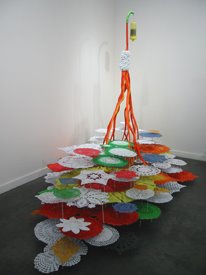
Another sculpture that commanded it space was Hector Dio Mendoza’s “Habitat,” in which a trap full of dead bees hangs above a profusion of doily-like flowers (photo below).

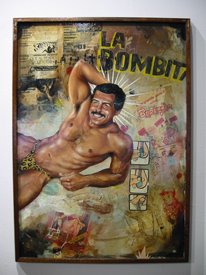
Using a barrio-wall aesthetic, Misty Avila Ovalles depicted a muscle man as the focal point for a medium sized painting that was worked from edge to edge (photo below).

Garth Viera offered three drawings. My favorite was an untitled piece that seemed to depict a hobo couple at rest (photo below).

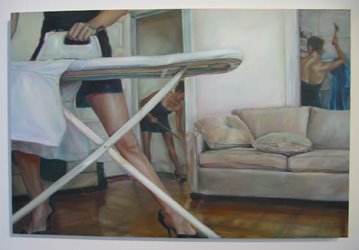
One of the several paintings by Ana Teresa Fernandez seemed technically and conceptually better than the others (photo below). It shows the artist (I think) wearing a sexy black dress and matching heels to iron a garment, clean a floor, and hammer a nail. It seems to portray the labor behind moments of glamour, perhaps a metaphor for the life of an artist.

Friday, April 21, 2006

Armory Show, Day 2

Here are some works I saw in March on my second day at this fair.

London’s White Cube had a large booth in the center of things. High on one wall was a neon scrawl by Tracy Emin, “Everything for Love” (photo at top). It served as a snarky general comment on the fair. Also at White Cube were selections from the full set of Goya’s “Los Caprichos” etchings as re-worked by Jake and Dinos Chapman. The brothers, famous for their cheek, have collaged the Goyas by meticulously overpainting cartoony imagery on the figures. Mostly they have created replacement heads that look like Carnival or Halloween masks. Sort of a James Ensor effect. Unfortunately, the project comes across as a prank, offering shock value without content. If you didn’t know they were Goya prints, you’d shrug your shoulders and walk on. The prices were up to snuff, though: about $23,000 per print.

At D’Amelio Terras (NY), there was a terrific untitled sculpture by Heather Rowe. Made of metal and wood framing, with remnants of wood veneer, it looked like a folding screen that had been destroyed except for its framework. Strategically placed bits of mirror dematerialized the piece even further. Looking at it, you doubted your eyes. I decided the piece was too hard to photograph. Fortunately James Wagner didn’t—see the two shots on his blog.

At China Art Objects (Los Angeles), I enjoyed seeing one of David Korty’s paintings (photo above). He depicts contemporary scenes with a sensibility that seems to draw on J.M.W. Turner, Monet, Cézanne, and Klimt. In his hands, even a garbage dump has become ravishing. Is this escapism? Is this critique? Maybe both at once, a love-hate thing.

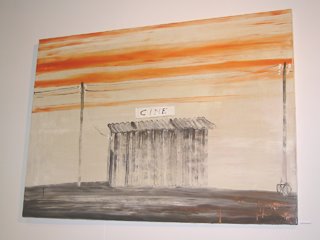
Produzentengalerie Hamburg offered paintings by Norbert Schwontkowski. He’s a mid-career German artist whose cultivated informal style projects a tone somewhere between whimsy and black humor. Sometimes his work resembles illustrations for the New Yorker or for a sophisticated storybook. But these associations did not press forward with the works on view. I liked “Cine” (about 110 x 140 cm, photo above) and “Captain in Love” (about 60 x 40 cm, photo below), which depicts an officer caught in the web of love.

Transmission Gallery (Glasgow) had David Sherry’s 5-minute video, “Smashing Every Aspect,” showing the artist banging a metal tray against the corner of a table, over and over. He had masking tape covering his face, like a Jason horror mask. At White Columns (NY), San Francisco artist Colter Jacobsen’s drawings looked good, and they were hot sellers.

At Leo Koenig (NY), Greg Bogin offered a sardonic logo for the planet, painted using automobile lacquer on canvas. The piece, about 36" x 30", is called “The Late Great Planet Earth” (photo above).

At Taxter & Spengemann (NY), Kalup Linzy’s video, “Lollipop,” was a hit. On a small monitor, Linzy and another man lipsync a blues song, the double-entendre kind, about whether the man is going to get his hands on Linzy’s “lollipop.” (Photo above.) This piece made camp seem fresh again. And it was technically stronger that Linzy’s videos in the “Frequency” show at the Studio Museum Harlem, a good sign.

Two other women artists caught my attention on Day 2. At Galerie Lelong (NY), I loved the dark Petah Coyne sculpture, "Untitled #1181 (Dante's Daphne)." Her work has an impact in person that photographs don’t seem to capture. At Wilkinson Gallery (London), I liked Joan Jonas’s B&W video from 1973, “Two Women,” a slowly rolling image of two women face to face.

Armory Show, Day 1

Here are some belated notes about the Armory Show, which I attended on March 10th and 11th.

This art fair, which started with 30 galleries at the Gramercy Hotel just 12 years ago, now presents nearly 150 galleries in two huge Manhattan piers. Sales are soaring, and one Los Angeles gallery owner described this fair as “the best in the past year.” For a viewer, though, the bigger the fair, the worse the experience. There are thousands of works to sort through, and the percentage of memorable work is staggeringly small. Entire countries, like France and South Korea, make a poor showing. Even if a work is decent, it can fade into the background. It's easy to miss things. I looked avidly, but came away with few photographs and not much longing. Here are some works I noticed on Day 1.
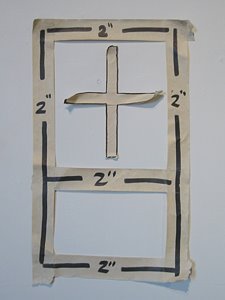
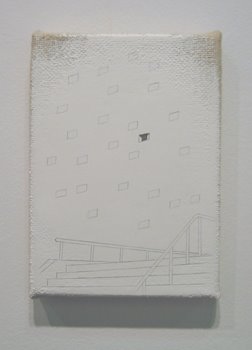
At Matthew Marks, a little 8" x 12" painting by Ugo Rondinone was eye-catching in its modesty (photo above).

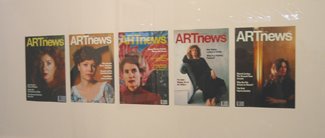
At Corri-Mora (London), a C-print by Anne Collier showed five 1980s issues of Art News featuring women on the cover (photo above). Collier, who was visiting the booth, said that she made the piece because she was fascinated by how the women presented themselves, especially the hair styles.

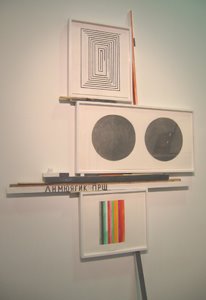
At Metro Pictures, there was an installation by Yuri Masnyj titled “This Ship Is Listing” (photo above). It carried out a de-Constructivist theme that was also explored in his work in the Whitney Biennial.

Pierogi (Booklyn) had a bizarre (and amusing) piece by Tavares Strachan, “The Problem of One Thing Existing Simultaneously.” Inside a vitrine there were pieces of a shattered beer bottle, and lying next to each fragment was a duplicate (photo above, from the Pierogi website). At Peter Blum (NY), there was a beautiful orange/pumpkin monochrome painting by Joseph Marioni. In the Armory context, it looked so classical.

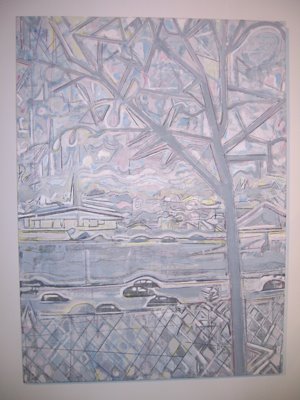
At Greenberg Van Doren (NY), a 48" x 72" oil painting by Benjamin Butler made me want to walk outside (photo above). All his paintings are based on trees.

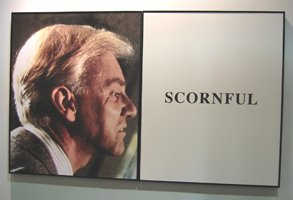
At Mai 37 Galerie (Zürich), I liked John Baldessari’s “Prima facie (Second State): Scornful.” It’s an archival digital print on canvas, about 77” wide (photo above).

At 303 Gallery (NY), I noticed a trompe l’oeil work by Berlin-based British artist Ceal Floyer. A photo of a tiny nail sticking out from a white wall was slide-projected onto an actual white wall. The edges of the photo were darkened, vignette-style. (An interesting choice.) This piece could have been yours for just 35,000 Euros.

“Smart Ass” at Southern Exposure

Southern Exposure’s recent exhibit was called “Smart Ass,” but I was a dumb-ass in neglecting to make a return visit. The day I saw the show, I needed to leave before watching Shannon Plumb’s videos or listening to the whole of Ben Riesman’s audio piece. I planned to go back and then blog about it in full. But I never made it.

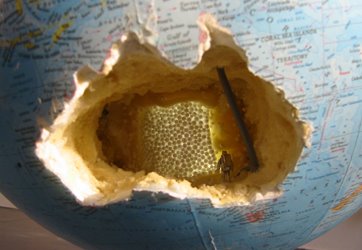
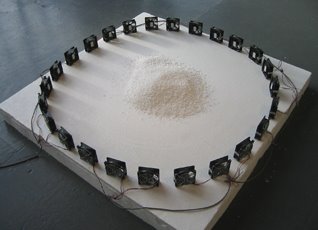
The exhibit was curated by Kelsey Nicholson. One standout was Dustin Fosnot, a young artist whose playfulness immediately lifts your spirits. He often uses Styrofoam as a material and likes to make contraptions that move Styrofoam pellets around. The sculptures look like models for larger constructions in a science museum or an offbeat theme park. In one piece, a circle of small fans blows Styro-pellets around like drifting snow (photo below). In another, an Earth globe is torn open to reveal a column of slowly moving Styro-pellets under the watchful eye of a tiny figure in a protective suit (photo at top).
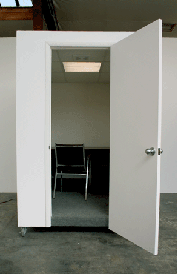
Ryan Thayer reprised a couple of his signature works. One was a huge version of his ceiling tile walls, in which a wall looks like an office building ceiling—ceiling tiles, florescent light panels, air ducts. Another was his take on office cubicles (photo below, adapted from the artist’s website).

I sampled Ben Riesman’s self-help audio, “Visualize Sleeping Your Way to the Top.” It was presented complete with a comfy armchair. I regret not hearing the whole piece, as the sample was enticing. Both in script and voice it was precisely calibrated to sound genuine.

Thursday, April 20, 2006

“Instant Messaging” at Gallery 16

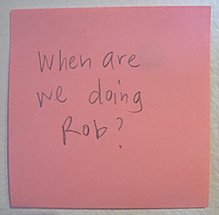
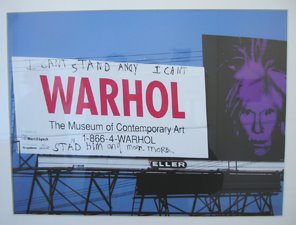
If you're in San Francisco's Potrero District on weekdays, you can spend a happy half-hour sampling Gallery 16's show of informal communications on paper. It's a gathering of Post-It notes, sketches, postcards, notebook pages, lost-pet signs, and so on. Here are a couple of grids from the show:

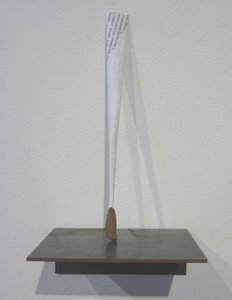
Below, on a shelf, is a message missile from a prison in Russia, found by Nigel Poor. The tip of the missile is made of bread.

Here's a detail from a large drawing by Lauren Davies, prompted by the irritations of art fair participation:

The show runs through May 12th. The gallery is open Monday through Friday, 9:00 am to 5:00 pm. The address is 1616 Sixteenth St. (third floor).

Stephan Pascher at Steven Wolf Fine Arts

Since opening his own gallery space a year ago, Steven Wolf has offered exhibitions with a strong bent toward the conceptual. He likes art that invites discourse. He likes to relate new work to the history of conceptual art, about which he knows a good deal. The latest installment in this program is Stephan Pascher’s “Lucky Chairs 2002-2005, and other arrangements…” In the main space, five carousel slide projectors chug through 255 different images of institutional chairs that are leaned or stacked in precarious balances, like acrobats (photo above, from the gallery website). The chairs are posed in front of a wall, and shadows of their acrobatics add to the texture and reality of the images.

The press release suggests that the tricky arrangements raise questions about authenticity in an age of digital manipulation. Well, perhaps. I was more interested in them as possible symbols of our rickety economic structure. But actually for me the overall effect of this installation was not ideas but a liberation from ideas. The chug of the projectors, located at the border between annoying and soothing, seems to disrupt thought. The insistent, unstable panorama of images has a Dada absurdity that lulls logic. I was sorry there weren’t actual chairs in the midst of all this, comfy ones, where a person could sit and zone out, perhaps sipping a cocktail or smoking hashish.

In the project room are some photographs of chair stacks, but these look badly framed. Another quibble is that the improvised pedestals for the projectors were unrewarding visually, despite their adherence to the procedure for this show.

Wednesday, April 19, 2006

Tonight: Danica Phelps at SFAI

Brooklyn artist Danica Phelps will give a talk tonight (April 19th) at San Francisco Art Institute. Her practice involves keeping detailed records of the financial and other aspects of her life and then using that documentation as a medium of exchange. The event is scheduled for 7:30 pm in the Lecture Hall at the 800 Chestnut St. campus.

Three Shows in the Mission (SF)

If you’ve ever felt schizo, here’s the show for you. Mission 17 presents an exhibit of video and photography by young artist Mark Lee Morris, under the title “Mark v. Mark.” The artist plays TV game shows against himself, he attempts to bluff himself in a poker game, and he partners himself in modern dance poses (photo above, from the gallery website). Is this narcissism or a critique thereof? You be the judge. There is an opening reception on Friday, April 21st, from 6:00 to 9:00 pm. The location is 2111 Mission St., at 17th St., on the 4th floor.

Not far away, at Artists’ Television Access, there is now a video in the window by an artist also claiming to be Mark Lee Morris. On the ATA website, he denounces the Mission 17 show. On the postcard for the Mission 17 show, he denies any involvement in the ATA show. Will a lawsuit be next? The ATA presentation runs through April 30th. The address is 992 Valencia St., at 21st St.
On April 7th, a small show called “Not for Sale” opened at Triple Base. Curator Nancy Meyer asked a few artists to lend favorite pieces from their own collections that were given or traded by other artists. There are good photos by Erik Seidenglanz (above top) and Roxanne Lowit, and also a vintage photo by Karlheinz Weinberger (above bottom, taken from Eyestorm site). Oliver Halsman Rosenberg did a mysterious wall installation, arranged in the form of a stick man, using materials from family life. Triple Base is the storefront at 3041 24th St., between Folsom and Harrison Sts.
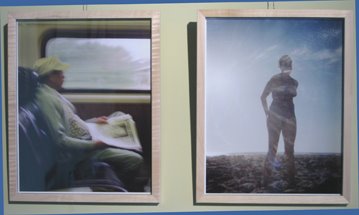
Finally, an offbeat little show of photography opened on April 14th at Arc Café, near Theater Artaud. It’s all about mistakes in photography, and it’s a good reminder that a mistake can be an opportunity. I stopped by before the lighting and the artist list were ready, but I managed one bad photo of Mariah Gartner’s two pieces (photo above) and noted interesting examples from Joshua Churchill and others. The café is on the corner of Mariposa St. and Florida St.

Nayland Blake’s Talk at SFAI

At SFAI on Monday night, New York artist Nayland Blake presented a slide-show retrospective of his wide-ranging work, while dispensing a veteran's advice about being an artist. He touched on many topics, including the gay and biracial content of his work, his preferred method of curating (works first, then the theme), and the artist’s responsibility to do something different. Several times he thanked people who made opportunities for him during the years he lived in San Francisco.

One food-for-thought remark was that content in an artist’s work develops “retrospectively.” He seemed to be saying that making work leads to meaning, rather than the reverse. And perhaps that meaning continues to accrue after the work is made, even for the artist. For keeping his work fresh, he described a tendency to react against those elements in previous work that could become shtick if repeated. He bemoaned the current tendency among young artists in New York to “work a tiny thing to death” so as to create an artistic identity and thereby make a living. He said that he advises young artists not to move to New York. In an aside about art writing, he said Artforum was most interesting and most readable when artists were doing the writing. (I think he meant the Sixties and Seventies.)

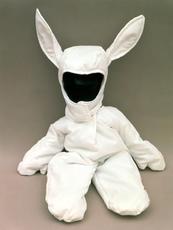
About his own work, I was surprised that he didn’t say more about the connection between his frequent representations of control—for example, arm and leg cuffs that suggest S&M—and of unfettered animality in the form of bunnies. (Pictured at top right is a sculpture from 1994 in which a child-sized nylon bunny suit covers a black porcelain figure, from the Cleveland Museum of Art website.)

A particularly interesting sidebar was his discussion of the use of photographs to document artwork. He announced that he has decided not to use photography to document his most recent work. This is because he’s grown suspicious of photography and the “tyranny of the image.” He made a distinction between the photograph and the image captured in a photograph that can detach itself from the photograph and function in the culture as a reduced or cliché version of the artist’s work. He noted that photography’s emphasis on the optical shortchanges work that also operates through sound, depth-perception, motion, smell, etc. He has noticed a tendency for photography to establish one viewpoint on a sculpture, and for young artists to make sculpture that fronts toward an imagined camera.

One way to sidestep the photography problem is to make work that is essentially immaterial. Blake has done this by placing online ads offering to finish any book that people haven’t been able to finish on their own. This note of humor ran through his talk, as it runs through his work. Even the scary restraint pieces make you laugh (nervously).

The artist has a blog that goes back several years.

Sunday, April 16, 2006

Alert: Nayland Blake Lecture at SFAI

A notable art event for Monday, April 17th: artist Nayland Blake will lecture at the San Francisco Art Institute. The event is scheduled for 7:30 pm in the Lecture Hall at the 800 Chestnut St. campus.

High School Artist Gets Gallery Deal

Is there a headline like that in our future? In yesterday's New York Times, Carol Vogel checks into the art world's youth-chase. (Read the article while access is free.) She provides a couple of interesting facts about a recent show at Jack Tilton Gallery, called "School Days," that featured the work of 19 MFA candidates from Yale, Columbia, and Hunter. The prices ranged from $2,000 to $16,000. Seventy percent of the work was sold before the show opened.

Vogel reports a counter-measure by Rochelle Feinstein, who's on the faculty at Yale's School of Art. She makes her students read reviews of the 1993 Whitney Biennial, and then asks how many of the artists they have heard of. Personally, I have found a reality check in gallery catalogs from prior decades that crop up in bookstores. You can see good work by artists who seem to have disappeared.

For additional sobering reading, I would suggest picking out a few chapters from a classic tome from 1841 that's still in print: Charles Mackay's Extraordinary Popular Delusions and the Madness of Crowds. It covers the South Sea Bubble in England, the Tulipomania in Holland, and other noted examples of speculative fever.

Saturday, April 15, 2006

“overundersidewaysdown” at QNA

At Queen’s Nails Annex (QNA), a storefront artist-run space, Margaret Tedesco has curated a show of three artists, using a title from the Yardbirds. The song is older than most visitors to the gallery, but it asks an up-to-date question: when will it end? That’s not the point of the show, though. The idea was to present a surround-sound experience in mixed media. But let’s not lean too hard on that.

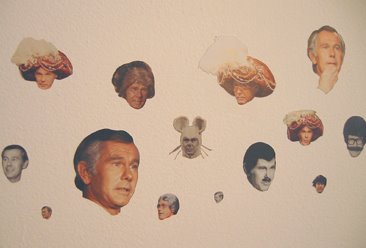
In the front room, Wayne Smith has splattered one wall with two sets of images. One set consists of small drawings on paper of lone surfers in the water. I assume these are based on photos. The images are covered by laborious cross-hatching in ballpoint pen, which creates several effects at once. They look pixelated, like TV. They look distanced, like memories. And they look a bit Japanese, like paintings on silk. (The lines played havoc with my camera; I couldn’t get a good image.) The work has an appeal, but I think a few larger drawings in this vein would have been more compelling. Cramming several dozen tiny drawings on the wall seems to trivialize the project. In the remaining area, Smith uses tiny images to better effect. He has affixed dozens of cut-out headshots of the (now dead) late-night TV host, Johnny Carson. They form a fizzy horizontal stream representing Carson through the years. It’s an homage to a public face (detail above).

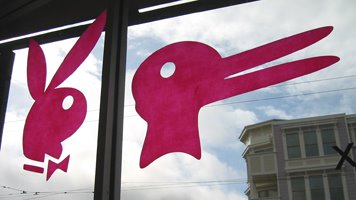
On the front window, David Hatcher (Los Angeles) installed graphics of two famous rabbits, the Playboy bunny symbol and what appears to be Wittgenstein’s version of the rabbit-or-duck illusion. Please decode this diptych for me so I know why I like it (photo above). Nearby, Hatcher painted the edge of a hole that happened to be in the wall (photo at top). Who said geometry can’t be seductive?

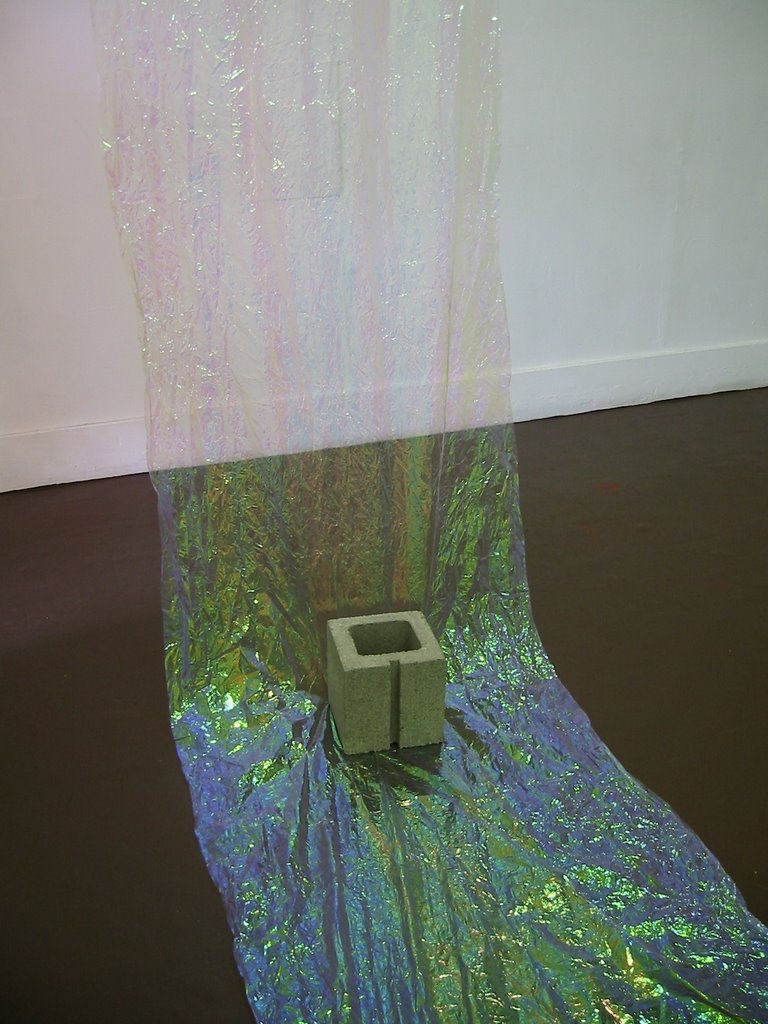
The back room is Mitzi Pederson’s domain. There are two large sculptures and two groups of small drawings. One construction, employing fairly simple means, shows off Pederson’s interest in the fundamentals of sculpture: opacity vs. transparency, lightness vs. weight, light absorption vs. reflection, blandness vs. gaudiness, tension vs. limpness, etc. (A detail is shown above.) The other sculpture carves out an even larger space, making the room feel crowded. It was hard to photograph in there. All in all, I felt that Pederson’s recent installation at the CCA graduate gallery, noted on March 30th, was more successful.

Friday, April 14, 2006

All Male Revue (“Manbox” at The LAB)

The new exhibition at The LAB is called “The Man Box and Beyond: an exhibit about masculinity and male identity.” The curator, Allegra Fortunati, based the title on an exercise developed at the Oakland Men’s Project, an exercise also known as the Gender Box or Act Like a Man. A description of the exercise is available on the website of the Family Violence Prevention Fund.

Fifteen artists were selected to participate via an open call for proposals. The standout for me was an audio piece, “Men Seeking,” by Chicago artist Scott Kildall. A nondescript cloth hangs against the corner of the gallery, as if to hide an ugly stain. There is narrow space between the cloth and the corner, enough for one person, maybe two, to stand up. Inside it’s dark because the fabric is lined in black. From a speaker at the top of this airless confessional, you hear a series of short phone recordings of men responding to a woman’s relationship ad. The are trying to sell themselves in about 30 seconds. You’ll laugh, you’ll cringe, maybe you’ll shed a tear. It’s a brilliant piece.

My second favorite was a large drawing by Jaime Cortez, called “Another Hero—The Assguardian” (photo at top). The media are color pencil and graphite on paper. The drawing is hung slightly away from the wall, to allow space behind the cutout letters that spell out the cry of “Never!”

Victor Barbieri contributes videos in which the participants look out at the viewer (photo above, from the artist’s website). One called “Friends” is a 3-channel portrait of a group of men. In two other videos, cute guys show off their physiques. One guy does “4 for you”—pushups, that is. The other makes a pitch in your direction, in “Boy with a Ball.” These two videos can be streamed from Barbieri’s website, from which the above image of the pushup guy has been extracted. (Also available is “Woman with Red Hair,” which was included in the “Truth and Lies” show that I helped curate at Mission 17.)

A video by Vancouver artist Daniel Anderson (“Cumulus”) is an ungainly combination of artful photography, slow pacing, mournful string music, and implied outdoor sex between a man and a little boy. Technically superb, it seems a victim of warring impulses. It tries to reveal and hide at the same time. It was almost as if, to avoid a charge of child pornography, the artist omitted anything that would seem too direct. There is no dialogue. There is no context. The viewer is left wondering what the meaning could be.

Jonn Herschend’s installation is a PowerPoint slide show with video inserts featuring himself as an actor. It’s called “What a Man Really Is, and What He is Not.” I thought the slides fell flat, but the video sections came alive because Herschend performs with a nicely judged hamminess. Memo to artist: show us, don’t tell us.

The rest of the show fell off rapidly in interest. Surely there was better work to be had. Another disappointment is the installation, which creates rampant sound bleed. You can be listening to one set of videos on headphones and hear three other pieces at the same time. I’m sure lack of funds played a part, but still it’s lamentable.